
hamster huey
Well-Known Member
I wanted to test my motor to see if its magnetic strength faded but without a gauss checker.
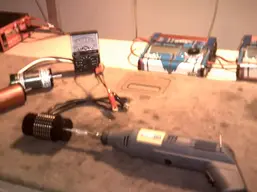
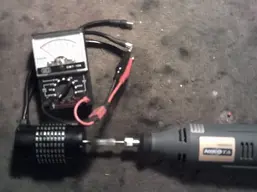
I came up with this. You need one new motor and/or one used motor. I checked ab,ac,and bc. This checks to see if a,b,c are shorted or broken as well. Basically if the old motor puts out the same voltage #s as the new motor I figured the magnets performance has not diminished. A digital mutimeter would work best. You can also test for shorts and breaks now too
I used a dremel w/some nitro fuel tubing to connect the shafts. I then ran the dremel at the same setting for both motors. I didnt even touch the setting between motors. I only disconnected the tubing and hit the on/off switch. The only down side is I had to have a brand new motor to compare the used one to. Another alternative is to record you dremel speed setting and test the motor when new. Then when you think your motor is worn put the same setting on the dremel and test ab,ab, and bc to see if you get the same voltages as when the motor was new. That should tell you if your magnetic strength has faded if the numbers arent the same.
This also works to tell you which motor is more powerful. I have one has very strong magnets when rotating by hand and one that doenst have as powerful magnets. Both are within 50kv of each other. I noticed the powerful magnet one has way more power in the vehicle and uses batts faster. So I was curious just how much more it had. The magnety put out 4volts and the less magnety only got 3 volts on the same dremel speed setting. That 33% more power (3 times 1.33=4).
Im comparing magnetic strength (TQ) when the dremel rpm is constant for both motors (same setting). HP comes from speed, TQ comes from physical strength. You need both. The best way of getting both is lower kv more volts.
I came up with this. You need one new motor and/or one used motor. I checked ab,ac,and bc. This checks to see if a,b,c are shorted or broken as well. Basically if the old motor puts out the same voltage #s as the new motor I figured the magnets performance has not diminished. A digital mutimeter would work best. You can also test for shorts and breaks now too
I used a dremel w/some nitro fuel tubing to connect the shafts. I then ran the dremel at the same setting for both motors. I didnt even touch the setting between motors. I only disconnected the tubing and hit the on/off switch. The only down side is I had to have a brand new motor to compare the used one to. Another alternative is to record you dremel speed setting and test the motor when new. Then when you think your motor is worn put the same setting on the dremel and test ab,ab, and bc to see if you get the same voltages as when the motor was new. That should tell you if your magnetic strength has faded if the numbers arent the same.
This also works to tell you which motor is more powerful. I have one has very strong magnets when rotating by hand and one that doenst have as powerful magnets. Both are within 50kv of each other. I noticed the powerful magnet one has way more power in the vehicle and uses batts faster. So I was curious just how much more it had. The magnety put out 4volts and the less magnety only got 3 volts on the same dremel speed setting. That 33% more power (3 times 1.33=4).
Im comparing magnetic strength (TQ) when the dremel rpm is constant for both motors (same setting). HP comes from speed, TQ comes from physical strength. You need both. The best way of getting both is lower kv more volts.
Last edited by a moderator: