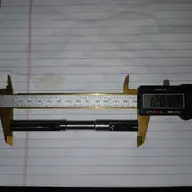
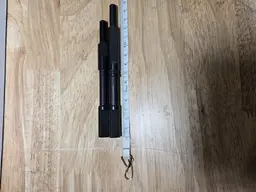
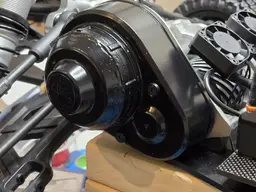
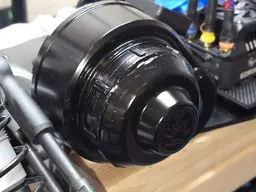
Sorry but you lost me a long time ago. Here are some more pics that might help.
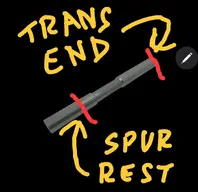
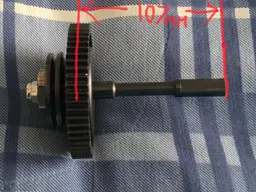
Unfortunately, those photos don't actual help. The point I've been trying to make all along is that the overall length of the layshaft isn't what's truly important. As clearly indicates by my photo, what's important is the measurement from the 'inside' end of the layshaft (ie. the end that's inside the transmission case, or the right red line in my photo), to the "midpoint" of the thickness of the spur gear (ie. the left red line in my photo). Looking at the photo I posted of the electric layshaft, with spur gear & slipper installed, that measurement is 107mm. Using the Taylor parts, I can see the possibility of at least two different measurements, and possibility as many as eight different measurements, which I can explain.
The carrier slides into the 'outside' end of the layshaft, and is held in place using a screw, correct? In other words, the screw holds the carrier in place the same way the screw on the opposite end of the layshaft holds the layshaft in place inside the transmission, correct? Also, it's my assumption that either end of the carrier can slide onto the layshaft...please, let me know if this assumption is correct, it not.
Continuing with my assumption that either end of the carrier can have towards the transmission case, and starting with the simplest of the Taylor assembly possibilities I was trying to explain, assuming that the 5 arms on the carrier are centered along the thickness of the carrier, and assuming that the screw attachment points (ie. where the spur attaches to the carrier) on the spur are also centered, that would give two different ways the assembled carrier & spur could go into the layshaft - the first is with the spur attached to the carrier, with the spur on the side of the carrier closest to the transmission case. The second is with the spur attached to the carrier, with the spur on the side of the carrier further from the transmission case. In other words, with the spur attached to the carrier, if you slide the carrier into the layshaft with the spur closer to the transmission case, the measurement from the center of the spur gear thickness, to the 'inside' end of the layshaft, will be one measurement. And, of you flip the carrier around, so that the spur is now on the side of the carrier further away from the transmission case, that same measurement would be slightly longer. Hopefully, to to this point, you're being what I was saying.
Assuming you got everything I explained in the above paragraph, explaining the rest is easier. In the previous example, the arms on the carrier are 'centered' along the thickness of the carrier, and the same was true for the spur & the spur's attachment points to the carrier. But, if either of those (the carrier OR the spur) have their attachment points off-center (meaning, the are closer to one side, and further from the other side), then that changes the number of possible measurements (from the center of the spur thickness (the left red line in my photo), to the 'inside' end of the layshaft (the right red line in my photo)) from 2 possibilities, to 4 possibilities. And, if the carrier-to-spur attachment points on BOTH (ie. the carrier AND the spur) are offset, then that increases the possibilities to 8. If you look at my photo, and take note of the red lines (ie. the distance needing to be measured), it's quite simple to understand what measurements are needed with the Taylor parts. However, the measurements can only be taken AFTER the layshaft, carrier, and spur gear are assembled (but NOT installed into the transmission).
If I had the parts, or even knew someone locally (Las Vegas area), then I could take the measurements myself, and post the data here. Unfortunately, I don't know anyone else in the Las Vegas area who even owns any Kraken RC vehicles. Hopefully, at least one person in this forum who owns the Taylor parts in question understands all I've explained, and can provide the measurements. Again, assuming that either end of the carrier can slide onto the layshaft, I know there are at least 2 possibilities, with as many as 8. Even with 8 possibilities, and having to reconfigure the parts to take the measurements, all 8 possibilities should be able to have measurements done in less than 15 minutes (probably less than 10).