
Steering Servo Mod - Improved Steering

This site may earn a commission from merchant affiliate
links, including eBay, Amazon, and others.

ImminentFailure

Well-Known Member
Messages
204
Reaction score
0
DemonRC mentioned this before, but I never saw any pics.


Simple mod for those who like to tinker. I figure I have a stock servo, lets use it until it dies (5755 Hitec is on the shelf waiting though lol)


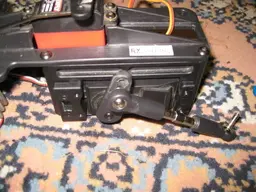
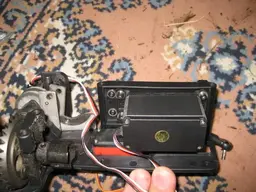
During my rebuild i moved the servo closer to body center, so i could flip the linkage to the outside of the horn for more torque. I went one hole lower, haven't tried any lower than that.


Pros:


- Improved torque


- Save $$$ over a Hitec


- 20 min project


- Combined with upgraded aluminum mount = awesome! (using ramtech one as 7075RC isn't out yet).


Cons:


- Stock horn flexes since torque is so high, can't figure out what crap ass size spline this thing is.


- Mounting screws on inside, harder to swap servo now.


Starting:
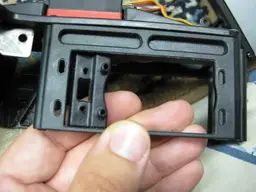

IMG_0003.webp


Had to buzz off the raised hex area on the horn so I could use the second hole.
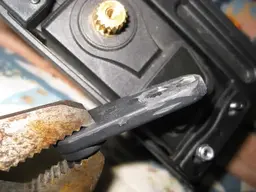

IMG_0025.webp


Looks gangster, but works.


IMG_0027.webp


IMG_0028.webp
 
your giving it less leverage by shorting the arm. that is more speed and less torgue.
 
auto2 said:
your giving it less leverage by shorting the arm. that is more speed and less torgue.
Actually it's the other way around. You will have more torque if it's closer to the center. Kinda works like gearing. Think of the servo being the pinion and the bell crank being the spur gear. The smaller the pinion = more torque. If you make the arm on the bell crank longer then you will get more leverage transferring more torque (bigger spur gear). Of course there is a trade off at some point...less travel if mounted too close to center of servo horn or if bell crank is too long it could take more travel than the servo can provide.

Another example would be winches. Max winch ratings are made with only 1 full wrap of cable around the drum. After each wrap the drum gets bigger in diameter and reduces the amount pulling capacity or torque.

I think the speed aspect is moot because the difference in the mounting holes is small. The longer the arm the further out it (linear travel) reaches per degree of movement. More distance per degree of rotation would more speed, but with less torque, so the speed may even out or get worse depending on the load.
 
RampageHopUps said:
Torque = distance x force. Since the servo has continuous force, the torque raises when the distance is farther.
This is how I always understood it. Just like using a longer armed wrench to get better torque. I thought maybe there was some black magic going on because i heard people saying to move it down. I thought two vector torque played in because standard torque uses a fixed rotation around the fulcrum (servo arm and gear in this case), and the direction torque is caused is 90 degree to it. This model would be shown with a servo link arm that was a constant 90 degrees to the horn, but due to the servo link changing the direction of the force applied at each point in the servo horn travel (since it's fixed to the server savor plane of travel), it would improve being lower.

I got a false positive on this one simply because i went to Rob's aluminum servo saver. Totally forgot to post here. I moved the arm back up a few days ago. I still can't tell if one is really better than the other with such a small change.

The true answer is don't flip this female dog around, just get the hitec from DDM with the free horn and the alum steering rack from Rampagehopups.
 
Last edited by a moderator:
RampageHopUps said:
Torque = distance x force. Since the servo has continuous force, the torque raises when the distance is farther.
That definition (edit: Should be formula not definition) is correct, but you need to put the items in the right place. Torque is twist or rotation. The servo is not applying the force it is the torque because it is the thing rotating. Force is what's needed to move the linkage at a givin distance.

Servos are rated on how much force they exert or move with a 1 inch horn.

Example:

If you have a 300 oz/in rated servo with a 1" horn and need exactly 300 oz of force to move the linkage attached to the wheels it should work...maybe on the brink straining that servo to death, but in an ideal world.

T = D x F

300 = 1 x 300

Lets move the hole 1/2 way (.5" from center)

300 = .5 x 600 (300 / .5 = 600)

You are now effectively applying 600 oz/in of force to the linkage.

Rob's right that the servo is the constant.

Now make the arm on the bell crank a little longer (like a longer wrench on the bolt) the servo's job is easier.

I thot the comparison to the gear ratios was good since a servo spins like a gear. The bigger the pinion the less torque output.
 
Last edited by a moderator:
That makes perfect sense. No wonder when I switched my RC 10 to the bell crank/server saver that has an arm twice as long as the stock, my servo suddenly seems like a beast. It made the arm attached to the pivot point longer, allowing the force applied at that fix point to exert more torque. Brilliant!
 
Yea I remember the RC10T's had a nice bell crank. Gave plenty of steering throw unlike my RC10GT. I still have a lot of RC10 stuff. Need to rebuild some.
 
Not to get too off topic hehe, but he's a shot of my runner. I burn it up at the local track. My brother gave it too me back in 1996. It's a 1990 CE.

IMG-20110714-00040.webp
 
Back
Top