

Navigation
Install the app
How to install the app on iOS
Follow along with the video below to see how to install our site as a web app on your home screen.
Note: This feature may not be available in some browsers.
More options
Style variation
You are using an out of date browser. It may not display this or other websites correctly.
You should upgrade or use an alternative browser.
You should upgrade or use an alternative browser.
lite weight flywheel issues
- Thread starter Rcnut24
- Start date
This site may earn a commission from merchant affiliate
links, including eBay, Amazon, and others.
links, including eBay, Amazon, and others.


- Messages
- 13,208
- Reaction score
- 22,962
Torque is unaffected, all its doing is helping to spool the engine faster.
- Messages
- 13,208
- Reaction score
- 22,962
No. The mass of the flywheel doesn't determine torque, it helps keep the inertia of the engine going, but that's a mass thing. The light flywheel doesn't help with that in the least and sctually hurts it. Lightened flywheels are just for spool time.

No. The mass of the flywheel doesn't determine torque, it helps keep the inertia of the engine going, but that's a mass thing. The light flywheel doesn't help with that in the least and sctually hurts it. Lightened flywheels are just for spool time.
 Yup
Yup
Roni92
Well-Known Member
- Messages
- 63
- Reaction score
- 25
No, to be exact you do lose some power to rotate flywheel and whole drivetrain under acceleration.No. The mass of the flywheel doesn't determine torque, it helps keep the inertia of the engine going, but that's a mass thing. The light flywheel doesn't help with that in the least and sctually hurts it. Lightened flywheels are just for spool time.
There's no free energy that accelerate your flywheel. Less energy spent accelerating flywheel = more energy (power) to the wheels.
The faster engine acceleration the bigger that difference will be.
In practice it's such small amount that I doubt it's even measurable in our small engines with anyway lightweight flywheel.
So practically you're right, but technically no, what you stated denies basic physics

But I see why one might think that, because your pulling power/ability isn't affected by inertia of drivetrain but power put to the wheels/acceleration is.
So Rcnut24 had the right idea, it's just probably too little energy loss to make measurable difference.
But if youd combine lightweight flywheel, with lighter diffs, lighter wheels, there's something to be gained for sure if you're about squeezing every last drop of power
Last edited:

I have a lightened, balanced fly wheel in my rooster tail 30.5 full mod reed, been running it hard over here in Australia, for two years.
No problemo at all
Like the other guy said get a rooster tail
With the exchange rate you would get a good deal, don't know what he charges for shipping, but it light & small so should be to much
No problemo at all
Like the other guy said get a rooster tail
With the exchange rate you would get a good deal, don't know what he charges for shipping, but it light & small so should be to much
- Messages
- 13,208
- Reaction score
- 22,962
nothing I said denied physics. The engine makes whatever power its going to make, light weight flywheels are a bad idea in single cylinder 2 stroke, actually crappy idea in 90% of engine even if multi cylinder, just especially stupid idea in an engine that relys on the kinetic energy stored by the flywheel to smooth out the power pulses. Keep taking that weight away in pursuit of "power" you're just hurting the engine not helping it. Keep in mind there more then just making stuff spin fast to making power and keeping an engine running.No, to be exact you do lose some power to rotate flywheel and whole drivetrain under acceleration.
There's no free energy that accelerate your flywheel. Less energy spent accelerating flywheel = more energy (power) to the wheels.
The faster engine acceleration the bigger that difference will be.
In practice it's such small amount that I doubt it's even measurable in our small engines with anyway lightweight flywheel.
So practically you're right, but technically no, what you stated denies basic physics
But I see why one might think that, because your pulling power/ability isn't affected by inertia of drivetrain but power put to the wheels/acceleration is.
So Rcnut24 had the right idea, it's just probably too little energy loss to make measurable difference.
But if youd combine lightweight flywheel, with lighter diffs, lighter wheels, there's something to be gained for sure if you're about squeezing every last drop of power

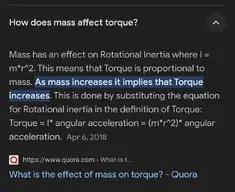
I'm going to argue that removing weight off the flywheel will decrease torque.

jeepfreak1972
Well-Known Member
- Messages
- 787
- Reaction score
- 749
Back in my 2 stroke dirt bike days it was common to add flywheel weights to a motocross bike when converting it to a woods bike because it helped with low speed tight trail riding. Reduced stalling and increased tractability at the sacrifice of quicker revving.I'm going to argue that removing weight off the flywheel will decrease torque.
View attachment 91720
@jeepfreak1972 I can see that making sense and why it would be wanted for riding in the woods. A small engine like these need the torque to help get these heavy rigs moving off the line. If you lighten the flywheel I'd suggest upping the engagement rpm on the clutch as you would need to take off at a higher rpm.
The point I make can be seen with F1 racing, they have all that horsepower but lack the torque they need to get moving so they have to rev it up and dump the clutch.
The point I make can be seen with F1 racing, they have all that horsepower but lack the torque they need to get moving so they have to rev it up and dump the clutch.
jeepfreak1972
Well-Known Member
- Messages
- 787
- Reaction score
- 749
I completely agree.@jeepfreak1972 I can see that making sense and why it would be wanted for riding in the woods. A small engine like these need the torque to help get these heavy rigs moving off the line. If you lighten the flywheel I'd suggest upping the engagement rpm on the clutch as you would need to take off at a higher rpm.
The point I make can be seen with F1 racing, they have all that horsepower but lack the torque they need to get moving so they have to rev it up and dump the clutch.
- Messages
- 13,208
- Reaction score
- 22,962
Bs. The engine makes whatever torque its going to, the flywheel has zip, zero, zilch to do with that. All your doing is decreasing the rotational mass, which will allow the engine to spool up quicker, but hurts keeping the power pulse smooth. Single cylinder engines benefit from having a heavier flywheel because of this, it's what keep the engine spinning, additionally you're loosing off peak rpm performance in the bottom end. All because you're seat of the pants dyno makes you think it's "better" doesn't mean it is. Multi cylinder engines profit from this only in certain applications. And to top that they are all better balanced and don't have to worry about keeping the inertia of the engine from one pwerstroke to the next.less rotating mass = more torque IMO.....I can notice a difference for sure.......I have since been lightening and balancing my own flywheels......and it has worked out perfect.
Ding, ding, ding we have a winner!!!!Back in my 2 stroke dirt bike days it was common to add flywheel weights to a motocross bike when converting it to a woods bike because it helped with low speed tight trail riding. Reduced stalling and increased tractability at the sacrifice of quicker revving.
jeepfreak1972
Well-Known Member
- Messages
- 787
- Reaction score
- 749
With the F1 example.I completely agree.

just because the engine is spooling up faster doesn't mean more torque is added to the engine. I can understand why you are thinking that, but if you think about it, it doesn't make any sense to add torque to the engine using a flywheel, it's not like it makes the engine bigger or adds compression. It can also be bad for cooling bc many of these lightened flywheels have smaller fins to take off the weight, so not as much air is being pushed to cool the engine.less rotating mass = more torque IMO.....I can notice a difference for sure.......I have since been lightening and balancing my own flywheels......and it has worked out perfect.
No extra power is being made by the engine if you do that, you are just losing less of it to the wheelsBut if youd combine lightweight flywheel, with lighter diffs, lighter wheels, there's something to be gained for sure if you're about squeezing every last drop of power
its not a matter of opinionless rotating mass = more torque IMO
Last edited:
jeepfreak1972
Well-Known Member
- Messages
- 787
- Reaction score
- 749
Below is from a motor trend article on this subject. Obviously its about cars but Physics is Physics.
Lightened flywheels reduce the amount of energy produced by an engine that's spent in moving its components (parasitic loss). Since flywheels are solid, unsprung components of a vehicle's driveline, a lightweight flywheel will decrease parasitic loss at a constant rate, improving a vehicle's horsepower and torque output (measured after the flywheel) throughout it's entire rev range.
The Verdict:
FICTION
At a constant rpm, horsepower and torque both change proportionately. If installing an aftermarket header, for example, seems to decrease torque but increase horsepower, the fact is that at the rpm where torque is decreased, so is horsepower (and vise versa)-changes are simply more apparent to horsepower at higher engine speeds, and torque at lower engine speeds, due to the function of calculating horsepower from torque. Installing a lightweight flywheel doesn't decrease torque, but it does decrease inertia, meaning more torque will be needed to break traction with a clutch-kick (drifting or burning out), or to accelerate a vehicle off the line during a launch (drag racing, daily driving).
Lightened flywheels reduce the amount of energy produced by an engine that's spent in moving its components (parasitic loss). Since flywheels are solid, unsprung components of a vehicle's driveline, a lightweight flywheel will decrease parasitic loss at a constant rate, improving a vehicle's horsepower and torque output (measured after the flywheel) throughout it's entire rev range.
The Verdict:
FICTION
At a constant rpm, horsepower and torque both change proportionately. If installing an aftermarket header, for example, seems to decrease torque but increase horsepower, the fact is that at the rpm where torque is decreased, so is horsepower (and vise versa)-changes are simply more apparent to horsepower at higher engine speeds, and torque at lower engine speeds, due to the function of calculating horsepower from torque. Installing a lightweight flywheel doesn't decrease torque, but it does decrease inertia, meaning more torque will be needed to break traction with a clutch-kick (drifting or burning out), or to accelerate a vehicle off the line during a launch (drag racing, daily driving).

Rcnut24
Well-Known Member
- Messages
- 115
- Reaction score
- 41
- Thread starter
- #38
I have proven to myself that the lighter flywheel vs stock one will get me threw and out of the corners faster on the make shift track in our back yard. I by no means meant to start any issues between myself and or any members on this thread..........Besides this hobby should be fun.....
jeepfreak1972
Well-Known Member
- Messages
- 787
- Reaction score
- 749
No issues here bud. I don't doubt you are feeling a difference. Even though we aren't riding or hanging on to these toys when we run them, we still "feel" how they react and perform with our eyes and ears. Through years of my own experience, more often than not, a more violent power delivery will feel quicker, even if its not vs a smoother one. But, they can also be quicker if they can get that power to the ground.I have proven to myself that the lighter flywheel vs stock one will get me threw and out of the corners faster on the make shift track in our back yard. I by no means meant to start any issues between myself and or any members on this thread..........Besides this hobby should be fun.....
Rcnut24
Well-Known Member
- Messages
- 115
- Reaction score
- 41
- Thread starter
- #40
In words with the gearing and so.................... the truck tends to break loose vs bite and bog down.......in addition I have two electric udr's that are a blast to drive because of the solid rear axle and locked diff. I change out the rear diff fluid in both DTT7 trucks to 1M. this causes both tires to even out the torque vs one wheel peel when the truck rolls over in the corner. loose is fast...........ive always heard. Plus I can drift the truck threw the corner and keep the rpms up.