
MonsterAir
Lone Racer 🤠
- Thread starter
- #41
Ahhhh, thanks for clearing that up!


Follow along with the video below to see how to install our site as a web app on your home screen.
Note: This feature may not be available in some browsers.

Broken strap on the spark plug? doesn't look to be real bad damage, and a bit of carbon on the top of the piston doesn't necessarily mean bad oil.Expecting a parts delivery tomorrow for my new/used rig, so I figured I'd pull the motor tonight and clean, re-ring and replace gaskets. Well look what I found! How do ya suppose that happened lol.
No deep scoring in the cylinder so I'm lost on how something like this would happen and talk about chitty oil. The last owner did not take care of this thing well.

Duhh on my part LOL, ya +/- 1 mm hence the 1mm gaskets they sellwhen fitting a 2mm stroke crank in your motor, the piston stroke goes up with 1mm and down stroke by 1mm.
1mm equals +- 8 deg. so your exh will go up with 8 deg but your inlet will open up 8 deg later. on the marine motors we use 1mm copper base gasket when building 2mm stroker motor.


if you are in the gas boats thing, this link below might be of your help in porting:hi gents. i am also new to gas cars and like to do my own port work. i am racing gas boats and modify my own motors. this is new ball game for me and i really look forward to mod my first baja motor. i read many guys like to used thinner gaskets or want to stroke motors, but by doing that you change the timings on the motor. funny that timing nrs are not mentioned anywhere, why? top secret detail? by swoping cranks and gaskets intake and exchaust timing change, and this is only the start by mod motors. thanks for a brilliant forum. i still have much to learn.
correct.Duhh on my part LOL, ya +/- 1 mm hence the 1mm gaskets they sell
That's about how I figured as well. The "factory ported" cylinders don't change timing numbers a bit.if you are in the gas boats thing, this link below might be of your help in porting:
RCMK Engine Modification
Engine Porting
correct.
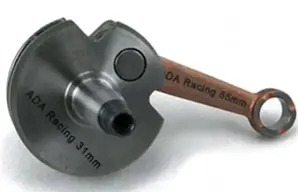
stroker crank means the same stock length of conrod but the pin on the "bigger" end is drilled 1mm outer vs original stock position. hence the conrod moves a little further to the outside... because of which you have to trim the crank case.
my understanding is that +2mm stroker means 1mm gain at TDC and another 1mm at the BDC.
IF you use a 1mm base gasket to accommodate the +2mm stroker crank, you need to trim the ports to restore the stock timing values.
IF you cut the squish band to accommodate the +2mm stroker crank, you do NOT need to trim the ports because they keep the stock timing values. (because the port windows relative position to the stroke won't change, BUT you need to cut the combustion chamber too to restore the stock compression rate)
again, it is just my understanding... (hope it's right)


Some good info right there??if you are in the gas boats thing, this link below might be of your help in porting:
RCMK Engine Modification
Engine Porting
correct.
stroker crank means the same stock length of conrod but the pin on the "bigger" end is drilled 1mm outer vs original stock position. hence the conrod moves a little further to the outside... because of which you have to trim the crank case.
my understanding is that +2mm stroker means 1mm gain at TDC and another 1mm at the BDC.
IF you use a 1mm base gasket to accommodate the +2mm stroker crank, you need to trim the ports to restore the stock timing values.
IF you cut the squish band to accommodate the +2mm stroker crank, you do NOT need to trim the ports because they keep the stock timing values. (because the port windows relative position to the stroke won't change, BUT you need to cut the combustion chamber too to restore the stock compression rate)
again, it is just my understanding... (hope it's right)
If you change the angle of the piston you need an oblong cylinder !My understanding is that long rods change the angle of piston and help increase rpms. I'm looking into +3mm stuffed crank with a 5mm long rod. More torque and more rpm. Not sure if it's offered for the 32cc engine though.
I'll probably have to have a custom head made up. I've also been wanting to try a balanced crank, anyone run one of them?

with higher torque you can gear up !Ya know that was what I thought originally but a lot of what I'm reading says it reduces friction which in turn would increase rpm, no? The 3+ and 5+ rod motors I have seen (listed online) were speed run motors so there has to be some type of rpm increase there I would think.
I also vaguely remember the long rods are prone to breaking under high torque situations.... It's been so long I'm trying to catch up to where I left off 5yrs ago. lol
Idk, poor design of the rod or material? Cant think of a too much torque being a major issue in one of these engine. I've heard of rods stretching and hitting the head, but I think that was a heat stress issue, or something like that.Ya know that was what I thought originally but a lot of what I'm reading says it reduces friction which in turn would increase rpm, no? The 3+ and 5+ rod motors I have seen (listed online) were speed run motors so there has to be some type of rpm increase there I would think.
I also vaguely remember the long rods are prone to breaking under high torque situations.... It's been so long I'm trying to catch up to where I left off 5yrs ago. lol
Register and gain access to Discussions, Reviews, Tech Tips, How to Articles, and much more - on the largest Large Scale RC community for RC enthusiasts that covers all aspects of the Large Scale RC!
Register Today It's free! This box will disappear once registered!